Automated Trading Bot
An automated trading bot is software that connects to a market (usually via API), follows rules or a strategy you define, and places buy or sell orders without you sitting on the chart all day.
This post is about how those bots work, where they help versus trading by hand, and what usually matters when you choose one.
What is an Automated Trading Bot?
A trading bot is a program that reads market data and places trades for you. You give it a strategy. It can fire orders faster than someone staring at candles, and it does not get tired at 3am.
Plenty of bots exist for stocks and forex. In crypto, most of them talk to your exchange through API keys. Your funds stay on the exchange; the bot only sends instructions.
That calm, rule-based execution is useful. It is also software that can lose money if the strategy or the risk settings are wrong, so you still need to watch it and update it.
Automated bot vs manual trading
| Automated bot | Manual trading | |
|---|---|---|
| Speed | Reacts when the rule hits | You have to be there and click |
| Emotions | Sticks to what you configured | Easy to panic or chase a pump |
| Availability | Keeps running while you sleep | Stops when you leave the screen |
| Consistency | Same logic every trade | Days where you skip or overtrade |
| Setup | Takes time to configure and test | Quicker to start, more work day to day |
Before going live, try backtesting or paper trading. Real funds can wait.
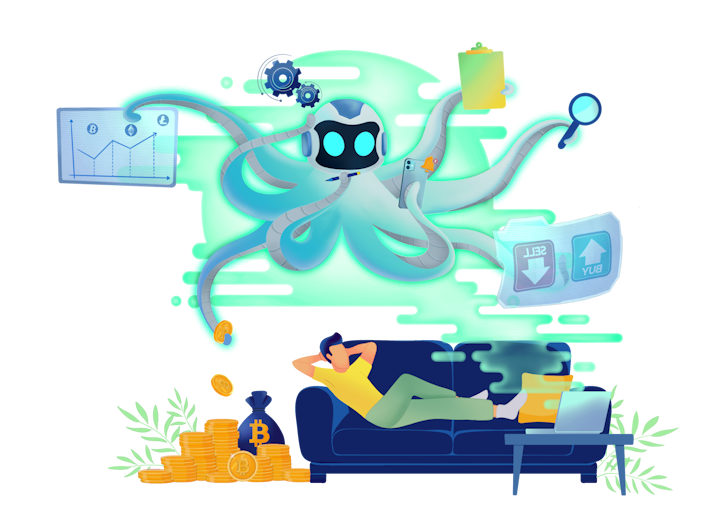
How Do Automated Trading Bots Work?
Under the hood, bots lean on algorithms (sometimes machine learning too) to read the market and send orders. You might point one at DCA, a grid, or something else you built. Speed is the obvious win; a person rarely matches that pace for long. A lot of setups also wire in indicators, stop-loss, and position sizing so the bot stays inside limits you chose.
We wrote a longer walkthrough of the data → decision → order loop in how a trading bot works.
Advantages of An Automated Trading Bot
Why people use them:
- Orders go out when the rules say so. You spend less time glued to charts.
- Fewer “I felt like buying” moments. The plan is already written down.
- You can change strategy later, or run quieter / busier periods, as long as capital and risk rules still make sense.
None of that deletes risk. A weak strategy on autopilot just loses money faster.
Select the Best Automated Trading Software
The market is crowded. A few practical filters:
- Can you explain the strategies in plain words (DCA, grid, whatever you pick)?
- Can you tweak risk and markets, or are you stuck with a black box?
- Stop-loss, position size, pause, paper trade. Boring tools, but they matter.
- Fees you can read, and ideally open source or at least visible performance.
On a tight budget, start with our best free crypto trading bots guide. Want paid and free side by side? See the best crypto trading bots ranking.

Top Automated Trading Strategies
A few you will see everywhere:
- DCA buys a fixed amount on a schedule, so entry price averages out over time.
- Grid lays buy and sell levels around a price and tries to catch the chop without calling the trend.
- AI-assisted setups score data and move faster than a manual scan. They still need hard risk limits and someone checking them.
Risk Management and Portfolio Optimization
Automation only helps if risk is written down:
- Stop-loss can cut a bad move before it eats the account.
- Position sizing answers how much each trade is allowed to hurt.
- Spreading across assets (for example crypto baskets) can reduce single-coin drama.
And do not curve-fit a backtest until the strategy only works on that history.
OctoBot: Your automated trading bot
One option in that space is OctoBot: open source, runnable on your machine or on OctoBot cloud, with ready-made strategies or ones you edit yourself. Paper trading and backtesting are available, and API keys stay on your side of the exchange connection.
If that is the route you want:
Conclusion
Bots can save time and keep you from trading every emotion. They also need a clear plan, honest tests, and risk limits. Pick software you actually understand, then start small.